

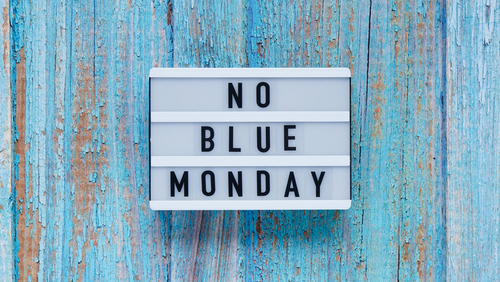
It’s quite common to have a lower mood in the winter. This is often referred to as the Winter Blues, as it coincides with the shorter, greyer winter days.
It would seem natural that after Christmas, our mood dips even lower, and it has been theorised that this fall in mood reaches its lowest point on the 3rd Monday of January each year.
What is the meaning of Blue Monday?
Blue Monday is a name given to a theoretically ‘most depressing day of the year’. It was calculated by a psychologist, Dr Cliff Arnall, in 2005. Dr Arnall was commissioned by Sky Travel to come up with a formula to target their marketing budget and to analyse why the holiday booking season peaked in the period just after Christmas.
What are the factors used in calculating Blue Monday?
The calculations include the number of long nights, the days since the last payday and debt after Christmas, bad weather, average daily temperature, and the number of days to the next bank holiday. However, the calculation has no quantitative studies to prove cause and effect or even links between these factors. Thus, the concept of the most depressing day of the year has no factual basis.
What day in January is Blue Monday?
In 2026, Blue Monday will fall on Monday, January 19th 2026.
How can you prevent the Winter Blues?
Whilst a lack of light is a key factor in the winter blues, it’s not the only area to focus on if you are trying to lift your mood. Our mental health is comprised of and can be lifted by a variety of factors. These will vary in importance depending on your circumstances. Acknowledging that you feel lower than you want to be is the first step to improving your mood.
Top Tips for helping with the Winter Blues
Here are some tips to help improve your mood and prevent the winter blues
1) Eat Well
A Mediterranean diet is regarded as best for physical and mental well-being. Make sure you eat lots of fibre for your gut bacteria to ferment. In addition, eat pickled or fermented food with probiotics already in it. It’s proven that a healthy gut biome will help you sleep better.
2) Drink lots of water
Water is vital for good mental health and sleep. Most adults need about 2 to 2.5 litres of fluid a day. However, avoid alcohol close to bedtime as it disrupts your sleep later in the night, and stop all caffeine at lunch time as drinking later can affect your sleep too.
3) Keep a regular sleep time
Getting to sleep and waking up at the same time 7 days a week is the bedrock of all sleep hygiene. However, if your social life at the weekend means you get to bed later, try to limit your weekend lie-in to a maximum of 90 minutes, as more than this totally disrupts your body clock and gut biome. Aim to avoid the snooze button and make sure you don’t lie in bed longer than 15 minutes in the morning. Getting out of bed promptly improves your sleep efficiency and your mood.
4) Get sunlight first thing
This improves your mood and strengthens your Circadian Rhythm or body clock, making it easier to get to sleep in the evening. Try to sit next to a window whilst you work, although getting natural sunlight is best. Try to get outside for 20 minutes a day, even when it’s dull.
5) Socialise with friends and family
Research has proven how important it is to be in touch with friends and family for our mental well-being. Aim to meet friends and family at least three times a week. If you can’t meet in person, you could FaceTime rather than call or text. It’s especially important to talk to your friends and family about how you feel, especially if you are feeling low.
6) Get regular exercise
20 minutes of cardio a day would be a great platform for both general and mental health. Going for a walk outside will help too. Exercise lifts our mood with endorphins and helps us get a better night’s sleep.
7) Have a morning and evening routine
When you wake in the morning, rather than go on your mobile straight away, try to do some positive affirmations and visualise a day where you remain calm and stress-free. This will help elevate your mood both first thing and throughout the day. Have a wind-down routine in the evening where you get off tech and relax for an hour before bed. Include a bath or shower, Yoga Nidra or evening meditation, all of which are proven to improve our sleep.
8) Take Vitamin D every day
It’s now recommended that we take vitamin D in the darker months. The NHS recommends that 10 micrograms a day is enough for most people. Also, don’t take more than 100 micrograms a day of Vitamin D ( 4,000 IU) as it could be harmful. Vitamin D aids both sleep and mental health.
9) Use a SAD lamp
If you get especially low in the winter, you could consider getting a SAD lamp. These can be used first thing in the morning to give you a dose of blue light, which mimics sunlight. Or you could even buy glasses which emit blue light, which most find more convenient, as you can get your dose of morning sun as you get ready for work
10) Speak to your GP
If you are struggling with feelings of depression, even over a short period, you should contact your GP. In this way, you can get support to prevent a more chronic bout of depression
I can also give you some personal support and tips to get your sleep back on track if this is the issue, too. Click this link for a free 30-minute consultation
https://aquamarine-squirrel-107177.hostingersite.com/contact/.